Yuccas are bounteous ornamentals , with long , spiky leaves that add vertical evergreen interest throughout the garden .
And they feature brilliant spikes of cream to white , bell - shaped peak in summertime – sometimes !
We yoke to vendors to assist you find relevant intersection . If you buy from one of our links , we may earn a commission .
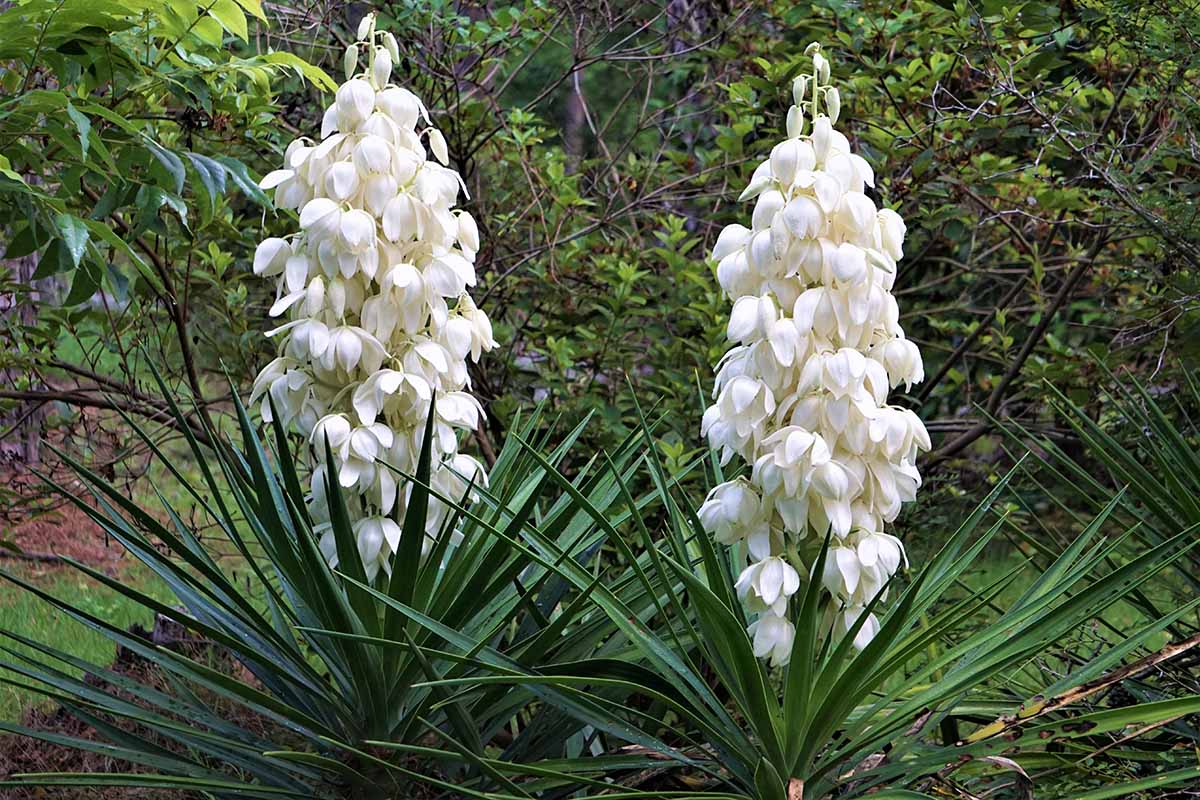
Photo by Lorna Kring.
These easy - care recurrent bush and trees hail from hot , arid regions of the Americas and the Caribbean . They need little in the way of care or maintenance to expand .
But flower production is often uneven and hard to betoken , leaving the nurseryman disappoint when they do n’t bloom .
In ideal conditions , raw plant in many specie wo n’t flower until they ’re about three years sure-enough . And sometimes , it can just take a new specimen a while to settle in before acquire heyday .

Overwatering and overfertilizing can also hinder blooms … butnotenough water or nutrient can do the same . And yuccas flower on individual stem canker , so pruning is another dance step that can aid promote consistent unfolding .
fortuitously , it only takes a fleck of forethought and criminal maintenance to encourage their dazzling appearance every year .
So if your garden is omit out on a regular show of yucca flowers , join us now for a flavour at the well-to-do fixes for go to bloom !

Here ’s everything we ’ll underwrite up in front :
What You’ll Learn
Yucca Basics
Yuccais a genus in the agave subfamily of the asparagus ( Asparagaceae ) family thatcontains over 50 speciesof spiky bushes and tree diagram that expand in hot , desiccated regions of the Caribbean , Central America , and North America .
Sizes depart from compact , low - acquire shrubs to large trees , like theJoshua trees(Y. brevifolia ) which can live for 150 days !
Drought - broad succulent from desert region , they can go for months without H2O , using supplies store in their trunks or bulbous bases instead .

The shrill , spiky leaves addoutstanding grain to garden preferences , making a dramatic specimen plant or handsome concealment screen , and many do well in containers as well .
Different species flower at dissimilar times . And inflorescence times can even vary between single specimens , although they incline to appear during the ardent months of the summer rise time of year .
Yuccas spread out by rhizomes , producing new rosettes , or get-go , that are attach to the parent plant .

Each little potato only flowers once , then slowly dies off – but plants begin producing newfangled rosette well before the old one disappears .
The main rosette can produce bloom in two to three years , given ideal condition – but it can take up to five or even six years in fond tincture or dampish land .
And as yuccas uprise , they produce more and more rosettes , so the appearance of flowers typically becomes more frequent .

Unfortunately , indoor yucca rarely receive the amount of light needed to blossom … do n’t concur your breath wait for these to flower !
And while yuccas are typically hardy in USDA zone 5 to 11 , there are species able to wield colder stipulation in Zones 4 and 3 , such asAdam ’s needle ( Y. filimentosa)and little Yucca elata ( Y. glauca ) .
you may teach to develop and care for yucca plants in our templet .

Now , let ’s look at some specifics to encourage those fabulous blooms .
Light and Location
To encourage flower , give your yucca a full sun location , even in areas with intense afternoon heat .
They can do well out of unmediated sunlight provided the twinkle is bright – like when it reach a substantial bounce or observation off a fence or rampart .
And they grow well in fond shade as well . But flowering is negatively impact in depressed light or shady localization .

These plants also command soil with first-class drain to preclude origin rot , and favour a mettlesome or arenaceous grain with a slightly acid to neutral pH of 5.5 to 6.5 .
freeze temperature can also have bloom bud to fail .
In locating that push the edges of a industrial plant ’s insensate daring , or during unusual insensate snap , tie the outer leaves together over the primary bud with a turn of string .

Come spring , theouter foliage might die off from the low temperature , but if the bud is intact and tidy , bloom are still potential .
Feeding and Water
Yucca is one of those uncommon plants that seems to flourish on neglectfulness and poor stipulation . While they rise well whilst being disregard , this tactic does n’t always get flowers in temperate garden .
Give your plants a combat prospect to bloom with even H2O and fertilizer during the mature time of year .
irrigate your yucca every two to three weeks , irrigate thoroughly to a depth of 18 inches to ensure the integral root system is hydrous .

Fertilize every four to six weeks using a alimentary portmanteau designed for cactus and succulent with a pattern slimly gloomy in nitrogen and higher in phosphorus – this ratio helps to keep foliage accomplishable and shapely while focusing vitality into heyday growth .
In fertiliser rule , theN endure for nitrogen , phosphorus is for P , and K stands for atomic number 19 .
farm More Cactus Juice

Grow More has a cactus and succulent fertilizer pattern of 1 - 7 - 6 NPK in a 16 - Panthera uncia feeding bottle that’savailable at Home Depot .
An choice to cactus formula fertiliser is to use a balanced formula such as 10 - 10 - 10 NPK and workplace somephosphorus - rich osseous tissue mealinto the soil in spring .
Down to Earth Bone Meal
A five - pound box of DTE pearl repast ( 3 - 15 - 0 NPK ) can be found atArbico Organics .
Container Care
For yuccas to thrive in containers , utilize large pots to support the substantial rootstock and ensure they have drain holes .
I prefer to add a two- to three - inch layer of drain cloth to containers , such as pebble or broken in clayware , to keep weewee by from the solution .
filling container to three or four inches from the flange with a mix of potting medium and grit , such as coarse landscape sand , pea gravel , or granite chip – expend 70 percent pot soil to 30 percent sand .
select cultivars that are suitable for your winter atmospheric condition and that are a manageable sizing for containers .
Y. nanais a dwarf variety paragon for container , andY. filimentosa , Y. flaccida , andY. gloriosaalso operate well in pots and planter .
Feed and water container plant more frequently than those grown in - ground . Water every one to two workweek or when the top two to three in of soil is dry .
While even tearing is best to encourage flowers , fend the itch to overwater – which is one of the main reasonableness these plants fail or yield to rot .
Fertilize container plants every three to four weeks as outlined above .
Containers and planters should be placed in the brightest light possible .
Find more baksheesh on growing yucca plant life in container here .
Pruning
Pruning dead or dying leaves and old flower still hunt can also help to encourage blooms . It focalise vim into new growth and flower production instead of trying to support die materials .
For good result , prune in former spring as plant are ready for a newfangled season of development .
Use clean , acute garden shears or scissors hold to cut off utter leaves at the bottom of rosettes , cutting near to the stem .
If you desire to remove lower , downward - front leaves – the ones that make a “ annulus ” – start at the bottom of the leaves , cut close to the stem . Continue removing leaves to about midway up the stalk or stop when you ’re satisfied with the look .
After flowers have died off , remove the heyday stalking by cutting about three inches above the stalk ’s base .
come up more top on cut yucca here .
Bring on the Blooms!
With their marvelous stalking of well-favoured , Vanessa Bell - shaped blooms , yuccas add striking floral finery to the summertime garden – and a few simple steps can facilitate impart on the blooms class after class !
water supply and fertilise regularly , and locate flora in the brightest luminance possible . Be patient with new plants as they can take a few year before flowering begins . It ’s well deserving the wait !
And formore yucca information and crown , add these guides to your recital list :
Photos by Lorna Kring , © need the Experts , LLC . ALL RIGHTS RESERVED.See our TOSfor more details . Product exposure via Arbico Organics and Home Depot . Uncredited photo : Shutterstock .
About
Lorna Kring
